Wailee Ming’s death and its concealment
Deception PointWailee Ming’s death and its concealment expose the collision between a scientific emergency and a carefully managed public announcement. When Ming’s body floats up in the extraction pit, NASA administrator Lawrence Ekstrom is told that the scientist is dead; with the press conference about an hour away, Ekstrom orders the body stowed and the accident kept secret until afterward. The decision turns a fatal accident into a test of institutional priorities: the discovery must reach the public on schedule, even as the organization withholds the death that has occurred in its midst.
The accident in the extraction pit
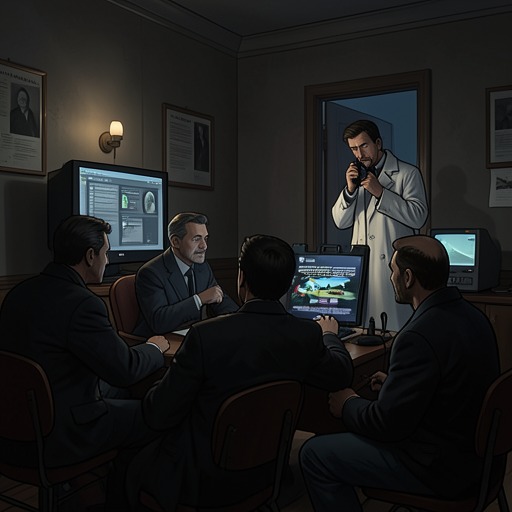
A young NASA technician rushes through the habisphere to find Ekstrom near the press area. The report is brief and alarming: a body has floated up in the extraction pit, and it is Dr. Wailee Ming. The technicians have pulled him from the water, but he is already dead. They estimate that he had been in the pit for about an hour. He appears to have fallen in and sunk; only after his body bloated did it rise to the surface.
The account establishes the immediate circumstances without supplying a fuller reconstruction of the fall. Ekstrom’s first response is to ask how long Ming has been in the pit, then to demand to know who else knows. The technician says that only two people do. The narrow circle of knowledge gives Ekstrom a chance to control what happens next, and makes the handling of the death a decision rather than simply a report of an accident.
Ekstrom orders silence
Ekstrom tells the technician to stow Ming’s body immediately and say nothing. When the technician hesitates at the implication that the body is to be hidden, Ekstrom frames the order as temporary: the death is tragic and he regrets it, he says, but this is not the time to deal with it openly. His explanation makes the timing explicit. The press conference is about an hour away, and an announcement of a fatal accident would overshadow the discovery and damage morale.
Ekstrom also assigns blame in a way that supports his decision. He calls Ming’s mistake careless and says he will not let the civilian scientists’ errors cast a shadow over NASA’s public moment of glory. He describes the civilians as having already taken enough of the spotlight, presenting disclosure not as a duty owed to the dead scientist or his colleagues but as a threat to the event NASA is about to stage. His conclusion is categorical: Ming’s accident is to remain secret until after the press conference. The technician, pale and perplexed, nods and agrees to stow the body.
A discovery under public management
The concealment occurs as the administration prepares to announce a discovery with consequences beyond the research team. President Zachary Herney has told Rachel Sexton that he will hold a White House press conference at eight that evening. He has arranged for four civilian scientists, independent of NASA, to examine the finding with their own equipment; their confirmation is meant to protect the announcement from accusations that NASA is promoting a discovery to defend its budget or assist the President politically. Herney nevertheless recognizes that the discovery will become a political issue as soon as he announces it.
That public timetable is the pressure behind Ekstrom’s order. He treats the death as information that can be withheld until the announcement has passed, while the discovery itself is prepared for worldwide release. The contrast is stark: independent observers are presented as a safeguard for the credibility of the scientific claim, yet the fatal accident inside the facility is confined to the smallest possible circle. The effort to manage one disclosure does not make the other more transparent; instead, the looming ceremony gives Ekstrom a reason to postpone it.
From physical evidence to institutional secrecy
The extraction pit belongs to a chain of measurements and interpretations that has already complicated the NASA team’s account of the find. The PODS satellite detected an anomalous object roughly two hundred feet beneath the ice, embedded in solid material and estimated at about ten feet across. Later, Rachel points out a limit in the satellite’s measurements: from 120 miles above Earth, its computers were designed to distinguish broad categories such as ice from slush, not necessarily to resolve smaller differences in density. Norah Mangor, insisting that the glacier is pristine, takes a sample from a melt pool and disputes the suggestion that the ice data are wrong.
The investigation turns to Ground Penetrating Radar, an instrument carried across the ice on a frame and powered by a marine battery. Unlike the satellite’s broad density scan, the GPR can register differences in the ice’s crystal structure: freshwater forms a flatter lattice, while seawater forms a more meshed pattern that scatters the radar reflections. The instrument is intended to print a cross-sectional image in which sea ice appears as a shadow. These competing methods make the site a place where evidence must be interpreted, challenged, and checked. Ming’s death interrupts that already tense work, but Ekstrom’s order directs attention away from the interruption and toward the public event.
The concealment also sits beside a separate institutional failure: PODS’s anomaly-detection software had failed, leaving the satellite unable to conduct the planned rapid search of Arctic ice for density anomalies. In the later account, Ekstrom is described as having persuaded the mission supervisor to lie about the software failure, a move Pickering says Ekstrom likely regretted once the meteorite received intense scrutiny. That retrospective qualification does not erase Ekstrom’s order over Ming’s death; it places the decision within a broader atmosphere in which officials control the timing and form of damaging information. Pickering says the President and NASA do not know about the meteorite deception and believe the find is authentic, distinguishing their innocence from the actions of those managing the hidden facts.
Significance and limits of the episode
Ming’s death is presented through a sudden report, not through a witnessed account of the fall. The reader receives the technician’s explanation of how the body sank and later surfaced, then watches the consequences take shape in Ekstrom’s immediate choices. This structure shifts the episode’s emphasis from the mechanics of the accident, which remain incompletely described, to the institutional response: who knows, who is told to stay silent, and what event is considered too important to interrupt.
The immediate outcome established in the scene is concealment until after the press conference, not a later public disclosure or an account of Ming’s death’s full aftermath. Within those limits, the episode gives the death a decisive narrative function. It shows the gap between NASA’s presentation of a scientifically verified triumph and the private decisions made to protect that presentation. A body recovered from the pit becomes an inconvenient fact to be stowed, while the announcement proceeds as the event around which the institution organizes its attention.